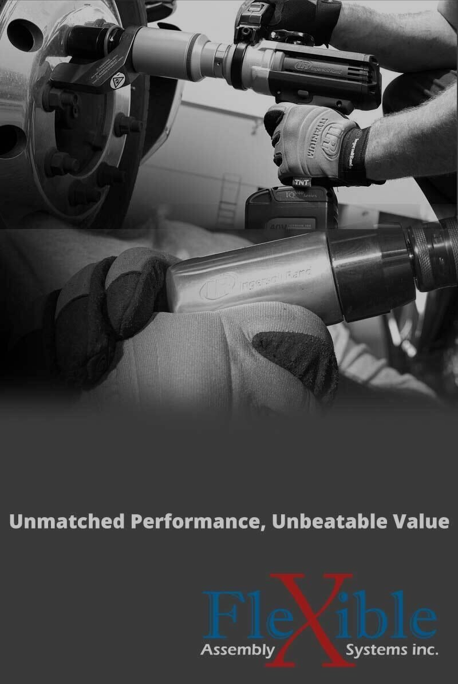

Torque Reaction Control
A torque arm (or torque reaction arm) removes most of the reaction load from the operator and transfers it to a rigid structure. In high-volume fastening, the torque arm is as much a quality device as it is an ergonomic device.
Key engineering considerations:
- Reaction path stiffness: Flex or play changes the feel at the tool and can affect how operators seat the fastener, especially on soft joints. Aim for rigid mounting, short reaction length where possible, and controlled articulation.
- Joint access and alignment: Misalignment between bit and screw axis drives cam-out, head damage, and torque spikes. A properly constrained arm helps maintain alignment, but it must allow the correct approach angle and clearance.
- Tool shutoff behavior: Clutch tools and transducerized DC tools react differently at shutoff. Reaction control should prevent “kick” and reduce post-shutoff movement that can mark the part.
- Operator influence reduction: With reaction managed, variability from grip strength and wrist angle drops, which improves repeatability and reduces the temptation to “help” the tool.
Limitations to plan around include fixture interference, reach envelope constraints, and the need to revalidate when changing tool models or tightening strategies.
Screw Feeding Systems
Screw feeders reduce handling time and eliminate many of the errors that come from manual picking, orienting, and starting a fastener. In high-volume cells, feeder performance is judged by feed reliability and how often the station stops—not by nominal feed rate.
Core design choices:
- Presentation method: Blow-feed, vacuum pick, rail feed, and bowl-based systems each have different sensitivities to screw geometry, coatings, and debris.
- Fastener and bit interface: Repeatable bit-to-head engagement matters. Worn bits, inconsistent screw recess quality, or poor seating at the nosepiece can cause cam-out and false torque signatures.
- Jam detection and recovery: Sensors should distinguish empty, misfed, and jammed conditions. Recovery steps need to be consistent so the restart does not introduce new risk.
- Part protection: Nosepiece contact points, screw escapement, and vacuum tips must be compatible with cosmetic and delicate surfaces common in electronics and interior automotive assemblies.
Feeders can introduce their own variation if they damage coatings, contaminate threads, or present screws at inconsistent angles. Include feeder maintenance in your control plan.
Station Integration in High-Volume Cells
Torque arms and feeders work best when designed as a single station, not bolted on later. The combined system should control three things: tool alignment, fastener presentation, and reaction management.
Practical integration checks:
- Confirm the arm’s neutral position supports straight-line approach at the fastener.
- Verify nosepiece clearance and that the feeder presents the screw without side load.
- Validate that reaction does not transfer into the part (thin sheet, plastic bosses) through the fixture.
- Ensure the operator can complete the cycle without twisting, reaching, or fighting the arm’s bearings.
Torque Verification and Audit Workflow
Torque arms and feeders improve repeatability, but they do not replace verification. Audits confirm that the installed joint meets requirements and that the tool system remains within control.
Torque testers in production audits
A torque tester (bench-mounted or portable) is commonly used to verify output torque of clutch tools or to check torque transducer behavior on certain tools. For audits, focus on:
- Accuracy and repeatability: Use a tester with suitable range so readings are not near the extremes of capacity. Repeat runs to quantify scatter.
- Operator influence: Clutch tools are sensitive to how the tool is held against the tester. Reaction fixtures and consistent technique reduce variability.
- Data capture and traceability: Record tool ID, serial number, tester ID, date/time, operator, environmental notes, and results. If electronic capture is available, ensure file integrity and access control.
- Calibration intervals: Set intervals based on usage, criticality, and historical drift, not calendar convenience. Tighten intervals after repairs, bit holder changes, or abnormal audit results.
Limitation: a tester measures tool output under test conditions, not the actual joint. If the joint is sensitive (prevailing torque, seating torque, lubrication effects), supplement with joint-based checks.
Torque screwdrivers for verification and troubleshooting
Torque screwdrivers are often used for verification of low-torque applications, setpoint checks, and controlled rework. They are useful when you need a portable, direct method with good tactile feedback and lower risk of damaging delicate assemblies.
Use cases:
- Confirming setpoints on small fasteners where a large tester setup is impractical.
- Controlled corrective action with documented torque on service or rework steps.
- Troubleshooting joint issues by comparing breakaway characteristics across parts or lots.
Limitations include higher operator influence compared to transducerized systems, and potential ambiguity between breakaway torque and installed torque. Define clearly whether the task is installation, verification, or breakaway measurement.
Audit documentation and control plan alignment
A workable audit process typically includes:
- Defined sampling frequency by station criticality.
- Pass/fail criteria tied to the engineering specification.
- Escalation rules (tool quarantine, retest, product hold) when results are out of tolerance.
- Maintenance triggers for feeder jams, bit wear rates, and arm bearing play.
Ergonomics, Throughput, and Reliability
Torque arms reduce fatigue and injury risk, which directly affects consistency on multi-shift lines. Screw feeders reduce micro-stoppages and dropped fasteners, but only if tuned for the fastener family and kept clean. Both systems improve long-term reliability when preventive maintenance is explicit: inspect arm joints for play, confirm reaction pads and stops, replace bits on condition, and track feeder jam rate as a leading indicator.
Why Choose Flexible Assembly Systems?
Flexible Assembly Systems supports high-volume fastening programs where torque control, verification, and documentation must align with manufacturing and quality requirements. The value for engineering teams comes from application-specific guidance on:
- Selecting and configuring torque arms for reaction stiffness, reach envelope, and fixture compatibility.
- Matching screw feeding methods to fastener geometry, coatings, and line-side maintenance constraints.
- Choosing torque testers and torque screwdrivers based on range, accuracy needs, repeatability expectations, and operator influence risks.
- Building calibration and traceability practices that fit regulated environments, including documented intervals, instrument control, and audit-ready records.
- Troubleshooting variation by separating tool output issues from joint effects and feeder presentation problems.
Conclusion
Torque arms and screw feeders are foundational to stable high-volume fastening because they reduce operator-driven variation and handling errors while improving station repeatability. Their benefits only hold when paired with disciplined torque verification using appropriate torque testers and torque screwdrivers, controlled calibration, and audit documentation that reflects real production conditions.